 Enu
EnuWondering how much does a dutch visa cost right now? In this post, you’ll learn the official Netherlands visa fees for common visa types, the extra service costs you may pay (like application center fees), and a simple way to estimate your real total before you apply.
Always double-check prices and rules on the official sites before you pay, because fees can change and some travelers qualify for fee waivers or lower rates. Start with the IND fee pages and the Netherlands Worldwide consular fee list: https://ind.nl/en/fees-costs-of-an-application and https://www.netherlandsworldwide.nl/visa-the-netherlands/fees.
Quick Answer (Read This First)
If you’re here for the fast version of how much does a dutch visa cost in 2026, focus on two numbers: the official government fee (what the Netherlands or EU sets) and the real total cost (official fee plus service and “paperwork” costs you can’t avoid). The official fee is only the start, like the ticket price before baggage and seat fees.
Here are the quick takeaways most people need:
- Schengen short-stay visa (Type C) fee: €90 for most adults, €45 for children aged 6 to 12, and free for children under 6 (EU-wide fee schedule).
- Application center service fees are extra: If you apply through a visa application center, expect an added service fee on top of the official visa fee. This charge can apply even when your visa fee is waived.
- Long-stay stays cost more: If you’re moving to the Netherlands (work, study, family), costs usually run through the IND (and can be several hundred euros depending on the permit).
- IND fees rose for 2026: The IND updates fees yearly, and the 2026 update includes an increase (confirm your exact category before you pay). See IND’s 2026 fee update.
- Example “higher-cost” permit: A Highly Skilled Migrant / EU Blue Card residence permit is listed at €423 (verify your exact route and fee on the official IND page).
- Fees are usually non-refundable: If you pay and later withdraw or get refused, you typically don’t get the fee back, so check requirements before paying.
- No hidden fees matters: If a third-party service promises “cheap” processing, read the fine print. Transparent providers highlight support, clear pricing, and privacy, often with dedicated help channels (call center and live chat), rather than surprise add-ons.
For the official sources, start with IND application fees and the Netherlands government’s visa info pages for your embassy or consulate.
Which Dutch visa do you actually need (because the cost depends on it)
Before you can price a Netherlands application, you need to name the right route. The biggest split is simple: under 90 days (a Schengen short-stay visa) versus more than 90 days (a long-stay route that often involves the IND). If you mix these up, you’ll get the wrong answer to “how much does a dutch visa cost”, and you might even pay the wrong fee.
One more thing: “visa” is often used as shorthand, but long stays are usually about a residence permit, with separate steps and costs.
Short stay (Schengen Type C): tourism, business, or family visit
This is the most common situation behind the question “how much does a dutch visa cost”. A Schengen Type C visa is for short trips like a holiday in Amsterdam, a business visit, or seeing family for a few weeks.
The key rule is the 90 days in 180 days rule. In plain language, it works like this: you can be in the Schengen area for up to 90 days total, counted within any rolling 180-day window. It’s not “90 days per trip” and it’s not “90 days every calendar half-year”. Think of it like a moving scoreboard that always looks back 180 days from today and counts your days inside.
That rule matters for cost because it tells you whether you’re in “short stay” territory or whether you’re actually planning a long stay and need a different, more expensive process.
You’ll also see two common formats:
- Single-entry: you can enter once, leave once. If you fly out, you can’t come back on the same visa.
- Multiple-entry: you can enter and leave more than once while the visa is valid, as long as you still respect the 90-in-180 limit.
For official fee lists and local currency payment details, start with a Netherlands Worldwide consular fees page (the page varies by country), such as Netherlands Worldwide consular fees example.
Long stay (MVV plus residence permit): work, study, or family plans
If you plan to stay more than 90 days, you’re usually not shopping for a “tourist visa” at all. You’re looking at a long-stay route connected to a residence permit. This is where costs can jump from a simple consular fee to IND fees (often hundreds of euros, depending on the permit type).
Many people experience long stay as a two-step process:
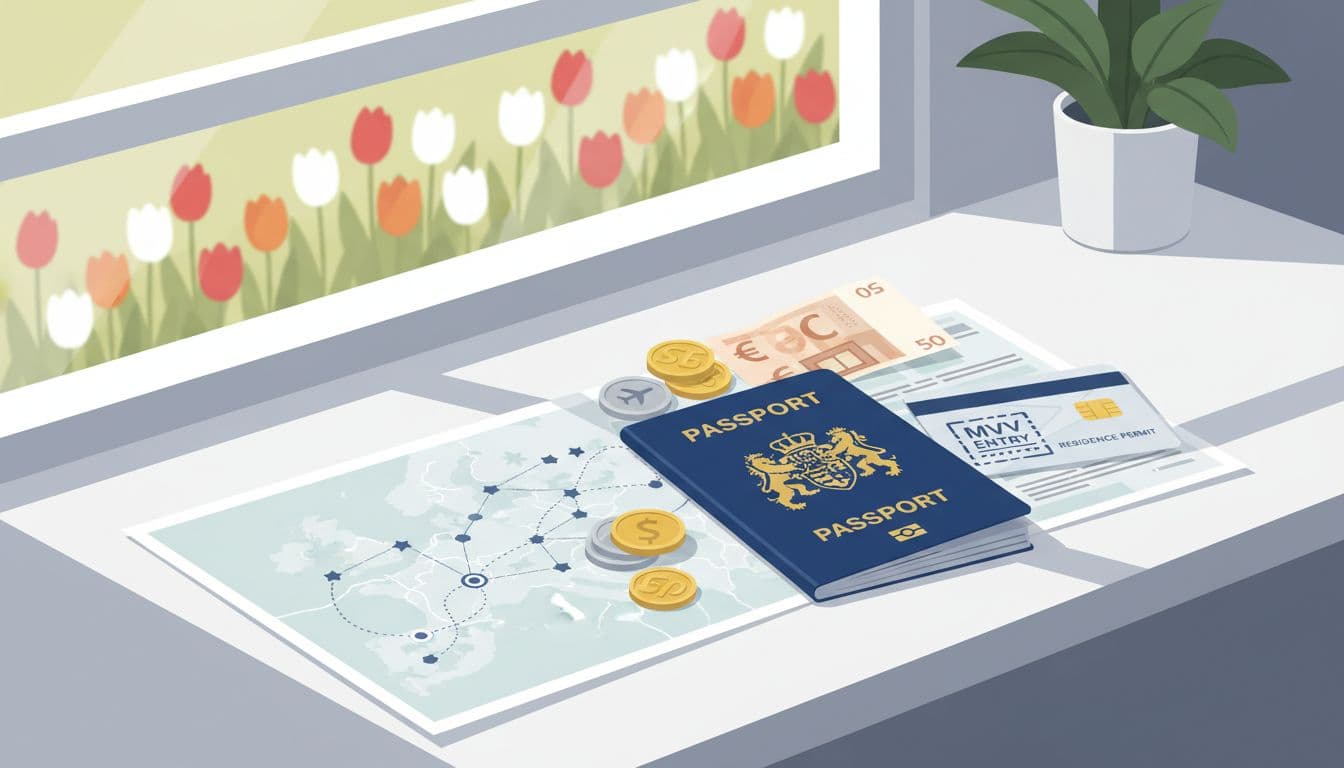
- MVV (entry visa sticker): a provisional residence permit placed in your passport so you can enter the Netherlands for a long stay.
- Residence permit with the IND: after approval (and often after arrival), the residence permit is issued and you pay the IND fee linked to your purpose, like work, study, or family.
That “MVV plus residence permit” structure is why long-stay costs feel more layered. You might pay a fee connected to the entry step, and a separate fee connected to the residence permit application itself.
Important nuance: not everyone needs an MVV. Whether you need it depends on your nationality and the route you take (for example, some categories and nationalities are exempt, and some processes are started by a sponsor like an employer or school). The IND explains when the MVV applies and how it fits into the long-stay process on its official page: IND explanation of the MVV process.
If you’re unsure which category fits, don’t guess based on a blog or a forum. Pick the right permit type on the IND site first, then you can price your real total with much more confidence.
Official Dutch visa fees you can expect (common examples)
When people ask how much does a dutch visa cost, they usually want the official, fixed fees first. These are the government-set amounts before you add extras like application center service fees, translations, travel insurance, or appointment add-ons.
Below are the most common examples, so you can sanity-check your budget quickly. Always confirm the latest numbers on official sources because fee tables can change, and some countries show the same fee converted into local currency.
Schengen visa (up to 90 days): adult, child, and free cases
For a short trip to the Netherlands (tourism, business, family visit), you’re typically looking at a Schengen short-stay visa (Type C). The official fee is standardized across Schengen.
Here’s what you can expect for the visa fee itself:
| Applicant | Official Schengen visa fee (Type C) |
|---|---|
| Adult (most applicants) | €90 |
| Child aged 6 to 12 | €45 |
| Child under 6 | €0 (free) |
That “free under 6” rule sounds simple, but real life often adds a catch: some applicants pay €0 for the visa fee and still pay a separate application center service fee (if you submit through a center rather than directly at a consulate). Think of it like a concert ticket that is free, but the booking fee still exists.
Also, some categories may be fee-exempt, depending on the purpose of travel and proof you provide. Common examples include:
- School pupils/students and accompanying teachers on school or study trips
- Researchers traveling for academic work (such as conferences or seminars)
- Under-25 applicants traveling for certain non-profit events (culture, sports, education)
These exemptions are case-based, and the decision depends on your documents and your specific situation. If you think you qualify, confirm the rules on an official consular fee page for your country (for example, Netherlands Worldwide consular fees) and the instructions from the application center handling your location.
MVV and residence permit fees: what you pay to enter vs what you pay to stay
For stays longer than 90 days, costs often feel confusing because you can pay for two different things:
- Entry permission (MVV): the “entry visa sticker” step for some nationalities and routes
- Residence permit (IND): the permit that actually covers your long stay in the Netherlands
In many long-stay routes, the MVV fee can look similar to the Schengen fee in the sense that it’s a defined government fee tied to the entry step. But for most people, the bigger cost is usually the IND residence permit fee, and that’s where you should focus your planning.
Two common, real-world IND fee examples (use these as a reference point, not a promise for your case):
- €423 example: often seen for work routes like Highly Skilled Migrant or the EU Blue Card
- €254 example: often seen for certain family or continued-residence situations
The key takeaway is simple: long-stay costs are driven by your purpose of stay (work, study, family, reunification, or other). So don’t rely on a forum estimate. Verify your exact category in the official IND fee table at IND fees and costs of an application.
The “real” total cost: service fees, translations, and other add-ons people miss
If you only budget for the official government fee, you’re setting yourself up for a surprise. When people ask how much does a dutch visa cost, what they really want is the all-in number, the one that hits your card after appointments, paperwork, and shipping.
Think of the official fee as the base fare. Your real total is the base fare plus the “bags”, the booking fee, and the admin costs you can’t skip.
Application center fees (VFS or TLScontact) and optional paid services
In many countries, you don’t submit directly to a consulate. You submit through an external application center, commonly VFS Global or TLScontact, and that usually comes with a separate service fee on top of the government visa fee.
This is the fee that catches people off guard, because it can apply even when the visa fee is reduced or waived. In other words, you might pay €0 for the visa and still pay a center fee to file it.
Here’s what to expect, in plain terms:
- Service fee (example range): often around €20 to €40 per applicant, depending on the location and the contract in that country.
- Optional paid services: these are not required, but they are easy to click when you’re stressed or short on time.
Common “add-ons” that quietly raise the total:
- SMS/email updates: small fee, but often per applicant.
- Courier return: convenient, but more expensive than collecting in person.
- Form-filling help: useful if you’re stuck, but not mandatory.
- Premium lounge or prime-time appointments: paying for comfort or better appointment slots.
Before you pay for extras, ask yourself one question: do you need help, or do you need speed? If it’s speed, the cost can be worth it. If it’s just anxiety, it’s often cheaper to slow down and double-check your checklist.
For location-specific center details, start with the official country page such as VFS Netherlands visa information, then switch to your own country from the menu.
Document costs: translations, legalization, and shipping your passport
Paperwork is where your “real” total can jump fast, especially if your documents are not already in an accepted language or format. You don’t feel these costs until you’re booking a translator, paying for stamps, and sending your passport by courier.
A quick, country-neutral checklist of documents that often trigger extra costs:
- Birth certificate: frequently needs a certified translation, and sometimes legalization (apostille or similar).
- Marriage certificate or divorce decree: same story, translation plus possible legalization.
- Police clearance certificate: can require special issuance rules, then translation.
- Bank statements and payslips: sometimes accepted as-is, but some applicants still need stamped copies or translations.
- Employer letters, sponsorship letters, invitation letters: may need notarized signatures or certified copies in some cases.
- Certified copies of passports or IDs: notary or municipality fees can apply.
- Return shipping or courier: if you don’t collect your passport in person, budget for courier both ways when offered.
Two practical tips that save money without cutting corners:
- Confirm what must be translated before you translate anything. Translating the wrong document is an expensive mistake.
- Batch your admin steps. If you need certified copies and legalization, do them in one run so you don’t pay rush fees twice.
To sanity-check what’s “normal” for Schengen applications, it helps to review a solid overview of typical documents and process steps, like this Schengen Type C guide.
Step-by-Step: How to estimate your Dutch visa cost before you apply
Before you pay anything, get your “real total” on paper. The official fee is only one piece of the puzzle. Your true cost is more like a grocery bill, the items add up fast when you include “small” extras like service fees, translations, courier returns, and last-minute document fixes.
Use the steps below to estimate your cost with confidence, so you’re not guessing when someone asks, how much does a dutch visa cost for your exact situation.
Step 1: Identify your route, then pull the official fee from a government source
Start by naming your route in one sentence: “I’m visiting for under 90 days” or “I’m moving for work/study/family.” That single decision changes everything, including who sets the fee and where you pay it.
Use this quick split:
- Short stay (Schengen Type C, up to 90 days): the fee follows EU Schengen rules, with age-based rates and possible exemptions.
- Long stay (often MVV plus residence permit): the main fee is usually the IND residence permit fee, and it varies by purpose (work, study, family, orientation year, etc.).
Two practical rules keep you from pricing the wrong thing:
- Don’t rely on forums for fees. They go out of date quickly, and people often mix up visa types.
- Match the fee to the payer. Sometimes you pay the government fee, other times a sponsor (like an employer or school) pays it and later charges you back.
For short-stay visa fees and exemptions, cross-check the Netherlands government guidance on visa fees and exemptions. It’s a clean starting point before you look at country-specific payment instructions.
Step 2: Add the “mandatory extras” that can apply even if the visa fee is €0
This is where most budgets break. People see “visa fee waived” and assume the whole process is free. In reality, you can still pay extra costs to submit the application and meet format rules.
Plan for these common “must haves”:
- Application center service fee: Many applicants submit through a visa application center (often VFS Global or TLScontact), which typically charges its own fee. This can apply even when the government visa fee is waived.
- Courier return (if you can’t collect in person): Convenient, but it’s a real cost, and it’s easy to add at checkout without thinking.
- Photos, printing, scanning: Small individually, annoying in a stack.
- Travel to your appointment: Train, fuel, parking, or even an overnight stay if the nearest center is far.
Keep your mindset simple: the official fee is the “entry ticket,” but the service fee is the “checkout fee.” Different bucket, separate payment, still part of your total.
When you compare help options, look for clear pricing and no hidden fees. Providers that emphasize transparency, privacy, and secure handling of documents tend to be easier to budget for. You also want access to real support (live chat or a call center) when you hit a snag, because last-minute mistakes cost money.
Step 3: Price your document workload (translations, legalization, and certified copies)
Document costs are the “silent” costs. They don’t show up in the visa fee table, but they can be the largest part of your total, especially for long-stay permits.
Start by listing what you might need, then ask two questions: “Does it need translation?” and “Does it need legalization or an apostille?”
Common cost drivers include:
- Civil documents: birth certificate, marriage certificate, divorce decree.
- Police clearance certificate: often time-sensitive and may require special issuance steps.
- Diplomas and transcripts: especially for study or some work routes.
- Proof of relationship or dependency: for family applications.
- Certified copies: notary or municipality fees can apply depending on where you live.
A budget-friendly way to handle this without cutting corners:
- Translate only what’s required. Translating extra documents “just in case” gets expensive fast.
- Batch tasks. If you need certified copies and legalization, do them in one round to avoid repeat trips and rush fees.
- Double-check document format rules early. Fixing a missing stamp on appointment day is the pricey way to learn.
If you’re using paid help, choose services that run error checks before submission. Catching mistakes early saves more money than people expect, because rebooking appointments and re-ordering documents costs both time and cash.
Step 4: Build your personal “real total” with a simple calculator-style formula
Now put it all together. Don’t overthink it, you’re building a decision number, not an accounting report.
Use this formula:
Real total = (government fee × number of applicants) + (service fee × number of applicants) + document costs + optional add-ons
Optional add-ons are things like premium appointment times, form-filling assistance, and SMS updates. They’re not always bad, but treat them like upgrades, not requirements.
Here’s a clearly labeled example calculation (not a quote, just a model you can copy):
- Government fee: €90 (1 adult short-stay applicant)
- Application center service fee: €35 (example)
- Photos and printing: €15 (example)
- Courier return: €25 (example)
Example total: €90 + €35 + €15 + €25 = €165
For long-stay routes, the same structure applies, but the government fee can be several hundred euros depending on the IND category. Multiply carefully if you’re applying as a family, because per-person fees add up quickly.
Step 5: “Before you pay” checklist to avoid paying twice
Fees are often non-refundable, and rework costs hurt. Do this quick check before you click pay or book add-ons.
- Confirm the visa type (short stay vs long stay) and your exact category.
- Check if you qualify for a fee exemption, then verify what still applies (service fees often do).
- Verify your document list and language rules, so you don’t pay for unnecessary translations.
- Review optional services one by one and only keep what you’ll use.
- Save receipts and screenshots of payments and appointment details for your records.
If you follow these steps, you’ll stop asking “how much does a dutch visa cost” in general, and you’ll know your number, with fewer surprises when payment day comes.
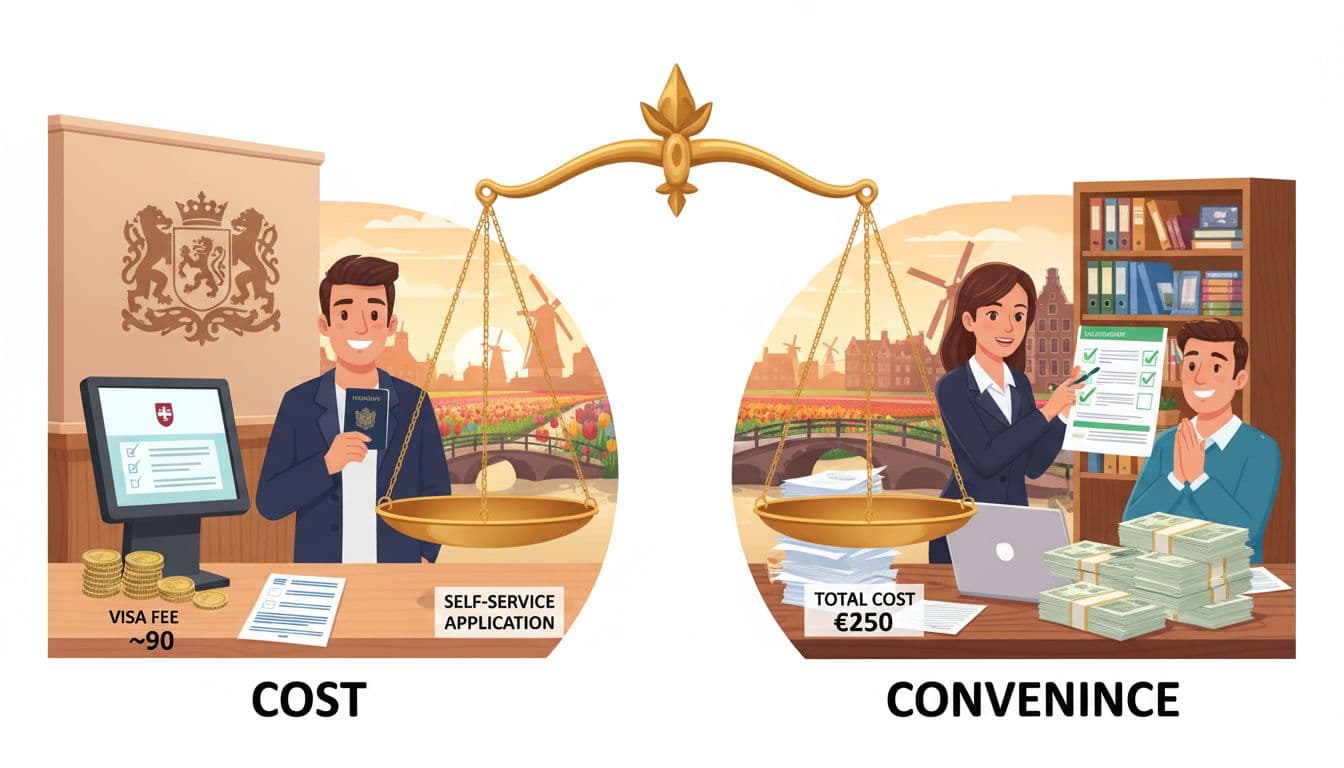
Pros and Cons of paying only official fees vs using a visa service
When you calculate how much does a dutch visa cost, you’ll quickly notice two very different paths. You can pay only the official government fees and do everything yourself, or you can add a paid visa service to reduce stress and paperwork risk.
There’s no “best” choice for everyone. The right move depends on how complex your case is, how confident you feel with forms and documents, and how expensive a mistake would be for you (missed flights, rebooked appointments, or a refused application).
Option 1: Pay only official fees (DIY application)
Going DIY usually means you pay the government fee, and any unavoidable third-party submission fees (for example, a visa application center fee where required). You control the process, the pace, and the budget.
The upside is simple: it’s often the lowest-cost route. If your case is straightforward, you can save real money by skipping paid “assistance” add-ons.
DIY is also cleaner for decision-making. You read the requirements, you match them to your documents, and you submit only what’s needed. For official fee basics, start with Netherlands visa costs overview and the official IND info hub at IND official guidance.
Pros of paying only official fees
DIY works best when your story fits the checklist, and you can follow instructions carefully. Think of it like assembling furniture from a manual. If the pieces are all there, you don’t need to hire help.
Here are the strongest advantages:
- Lower out-of-pocket cost: You avoid third-party service markups.
- Full transparency: You see what you pay and why you pay it.
- Direct control over your documents: Less back-and-forth, fewer hands on your paperwork.
- Less risk of paying for unnecessary extras: Some services push upgrades (courier, form filling, premium time slots) that you may not need.
If your main goal is keeping the total down, DIY is usually the best answer to “how much does a dutch visa cost” for your situation.
Cons of paying only official fees
DIY is cheaper, but it asks more from you. The biggest cost is not money, it’s time and attention. One missed detail can send you into a loop of rebooking and reprinting.
Common downsides:
- You carry the error risk: Wrong dates, missing signatures, or mismatched documents can derail an application.
- More time spent on admin: Forms, appointment booking, photo rules, printing, scanning, and organizing evidence.
- Harder when your case is “non-standard”: Mixed passports, complex travel history, unclear funding, or family situations need extra care.
- Support is limited: Official channels provide guidance, but they won’t fill in your forms for you.
If you’re already overwhelmed, DIY can feel like saving €100 and paying with 10 hours of stress.
Option 2: Use a visa service (agency or assisted application)
A visa service typically checks your application, helps organize documents, and guides you through submission. Some offer live chat, call centers, and status updates, which can be a relief when you’re trying to meet a deadline.
Good services also sell the idea of accuracy, privacy, and transparency. That matters, because you’re handing over sensitive documents. When a provider is upfront about pricing and has no hidden fees, it’s easier to budget and trust the process.
The tradeoff is that you pay for convenience. Your “real total” goes up, even though the official government fee stays the same.
Pros of using a visa service
A visa service can be worth it when the application is high-stakes. If a refusal or delay would cost you more than the service fee, paying for help can be a smart insurance-like choice.
Key benefits include:
- Fewer mistakes: Many services do pre-checks that catch missing fields and document gaps.
- Less mental load: You get a clear checklist, reminders, and guided steps.
- Better for complex cases: Work or long-stay paths, sponsor documents, and multi-person applications often benefit from structure.
- Human support when you’re stuck: Having someone answer questions quickly can prevent last-minute errors.
This is why, for some people, the best answer to how much does a dutch visa cost is not “the cheapest number”, it’s “the cheapest number that still feels safe”.
Cons of using a visa service
Paying for help can also be wasted money if your case is simple. And not all services add real value.
Watch for these drawbacks:
- Higher total cost: You add service fees on top of official fees and required submission costs.
- “Upsells” that inflate the bill: Form-filling, premium appointments, courier delivery, and SMS alerts can stack up fast.
- False expectations: No third party can guarantee approval or speed up government decision-making.
- More data sharing: You’re giving personal info to another company, so privacy policies matter.
If you want a reality check on what is truly required versus “nice to have”, compare your plan with a neutral explainer like visa requirements overview.
Quick decision guide (pick the best fit for you)
Use this simple rule: pay for help when the cost of getting it wrong is higher than the service fee.
A quick way to decide:
- If your trip is flexible and your case is simple, go DIY and keep costs down.
- If you have a tight timeline, complex documents, or zero time to triple-check details, consider paid help.
- If you’re mainly worried about fees, start with the official numbers first, then price support as an optional upgrade.
Here’s a snapshot comparison you can use while budgeting.
| What you’re optimizing for | Pay only official fees | Use a visa service |
|---|---|---|
| Lowest total cost | Strong fit | Often a poor fit |
| Less time spent on paperwork | Weak fit | Strong fit |
| Confidence you didn’t miss a detail | Depends on you | Often higher |
| Best for complex situations | Sometimes hard | Often better |
| Transparency and control | High | Varies by provider |
| Privacy exposure | Lower | Higher (more parties involved) |
FAQs about Dutch visa costs (refunds, exemptions, and common surprises)
Visa pricing sounds simple until you get to the checkout moment. That’s when people realize the “official fee” is only one piece of the puzzle, and some payments stick even if your application doesn’t work out.
Below are the most common questions that come up when you’re trying to pin down how much does a dutch visa cost in real life, with clear answers on refunds, exemptions, and the sneaky extras that can raise your total.

If my Dutch visa is refused, do I get my money back?
In most cases, no. The fee is usually treated as a processing charge, not a “success fee”. So if your Schengen visa (Type C) is refused, or you withdraw after paying, the government fee is generally not refunded.
That’s why it’s smart to view the fee like paying for an exam attempt. You pay for the review, not for the grade. If you want the safest path, double-check your documents before you submit, because a refusal can cost you the fee plus the time spent waiting.
If you’re budgeting for 2026, keep in mind that fees can change from year to year. The IND publishes fee updates, and those new numbers apply when you file, not when you started planning.
What if I cancel my appointment or don’t show up?
This is one of the most painful “small mistakes” because it feels avoidable. If you miss an appointment, you may lose:
- The appointment slot (and have to book again)
- Any paid add-ons tied to the appointment (depending on the provider’s policy)
- Time (which can be the most expensive part if flights or events are fixed)
Even when the government fee itself isn’t refunded, the bigger cost is often the domino effect: new appointment, new travel to the center, and sometimes re-issued documents if they expire.
If your plans are uncertain, book an appointment only when your paperwork is ready, not when you’re still “almost ready”.
Who can get a fee exemption (or pay less)?
Some applicants can pay less, or even €0, for the government fee depending on age and purpose of travel. The classic example is children under a certain age for Schengen visas, and some education, research, or youth non-profit event categories.
The catch is that exemptions are rule-based and evidence-based. You usually need to prove you fall into the category with the right documents (school letters, invitations, event proof, etc.). If your documents don’t clearly match, you may end up paying the full fee anyway.
Also, don’t assume “exempt” means “free trip to the application center”. In many countries, the submission partner still charges a service fee.
Do I still pay the visa application center fee if the visa fee is €0?
Often, yes. This is the most common surprise for families and students. The government visa fee can be waived or reduced, but the application center service fee may still apply because it covers intake and admin, not the decision.
Think of it like free entry to a museum on a special day, but you still pay for the audio guide if you want it. Different cost, different rule.
Before you celebrate a €0 government fee, check the center’s payment page and bring a card that works for local payment rules.
Are there “hidden fees” people don’t expect?
Not always hidden, but often easy to miss. Many costs show up as optional tick boxes when you’re stressed, rushing, or afraid of making mistakes.
Common add-ons that raise your total:
- Courier return for your passport
- SMS or email updates
- Form-filling assistance
- Premium lounge or priority time slots (where offered)
- Extra photocopies and printing at the center
Some applicants like paid help because it feels safer. If you choose it, pick services that are clear about pricing and what you get (support channels like live chat or a call center, clear transparency, and privacy protections), so your budget doesn’t drift.
Why do the numbers online look different from what I’m asked to pay?
Three reasons explain most “but Google said…” moments:
- Old info: fees can update yearly, and older articles keep ranking.
- Currency conversion: some consulates list fees in local currency, and exchange rates move.
- Mixed visa types: people confuse Schengen short-stay costs with IND residence permit fees.
If you’re comparing routes, watch for this trap: the Schengen visa is for short stays, but work, study, and family long stays are usually an IND residence permit route, with very different fees.
Is the MVV a separate cost, or included in the residence permit fee?
It depends on your situation and route. Some long-stay processes bundle steps so you don’t experience it as “two separate invoices”, while others feel like a layered process (entry permission plus the residence permit part).
The safest budgeting move is simple: plan for the residence permit fee first (the bigger amount), then confirm if any extra entry-step costs apply for your nationality and permit type.
Any common 2026 surprise for frequent travelers: ETIAS
This isn’t a Dutch visa, but it will still affect what you pay to travel to Schengen once it’s in force. If you’re visa-exempt and used to paying nothing beyond flights and insurance, ETIAS adds a small authorization fee. For the current fee and age rules, see the ETIAS fee overview.
Treat it like a small toll on the highway, not a visa. It’s still a line item that can change your total cost planning for 2026 travel.
What’s the quickest way to avoid paying twice?
Use this mini-checklist before you submit. It’s boring, but it saves money:
- Match the visa type to your trip length and purpose.
- Confirm fee exemptions using your exact category, not a guess.
- Don’t buy add-ons unless you know why you need them.
- Check document expiry dates (bank statements, insurance, letters).
- Submit when ready, not when you’re hoping it works out.
If you do this, your answer to how much does a dutch visa cost becomes a number you can trust, not a number you argue with at checkout.
Conclusion
The clean way to price a Netherlands application is simple: pick your visa type first (Schengen short stay vs IND long stay), confirm the official fee on a government page, then add the costs that make up your real total, like the application center service fee and document work (translations, legalisation, photos, courier). That framework keeps you from mixing visa categories, and it gives you a number you can trust when you’re deciding how much does a dutch visa cost.
Next, check the Netherlands government pages that match your nationality and purpose, then build a personal cost checklist before you pay anything. Keep it practical: write down the government fee, the service center fee, and every document you must order or translate, then decide which optional add-ons are actually worth it. Thanks for reading, if you found a fee difference in your country, share it so others can budget better.


 Enu
Enu