 Enu
EnuOne missing paper can push a visa decision back by weeks. For Nigerian students in 2026, the hard part is not collecting documents, it is collecting the right ones in the right form.
A student visa checklist Nigeria applicants can trust has to match the destination, the course, and the current visa rulebook. Requirements differ by country, and they can change without much warning, so we always confirm the latest list with the official embassy, consulate, immigration office, or visa-centre source before we pay any fee.
If we are still choosing where to study, our planning your study abroad journey helps us sort the big decisions first. Once the country is fixed, the document work becomes much easier to manage.
Why one checklist never fits every destination
A UK file does not look like a U.S. file, and neither looks like an Australian one. That sounds obvious, but plenty of refusals start with a simple mistake, using a generic checklist and assuming it fits every embassy.
The destination decides the shape of the application. Some countries want a CAS, others want an I-20 or a COE. Some ask for a TB test, some ask for a visa interview, and some want both. The school level matters too. Undergraduate, postgraduate, diploma, and pathway students may all face slightly different proof requirements.
A neat file does not fix weak evidence, but a messy file can spoil a strong one.
That is why we start with the country and then build the folder around it. If we try to do it the other way around, we end up paying for the wrong medical test, printing the wrong form, or chasing a bank statement that does not meet the rule. For the full application flow, our step-by-step student visa application guide is a useful companion once the document pile is ready.
The core documents most Nigerian applicants need
Some papers show up again and again, no matter where we apply. The exact order and format change, but the backbone is usually the same.
| Document | Why it matters | Common mistake |
|---|---|---|
| Valid passport | Proves identity and travel eligibility | Passport expires too soon |
| Admission letter | Confirms the school and course | Name or course dates do not match other papers |
| Proof of funds | Shows we can pay tuition and living costs | Unclear source of money |
| Academic records | Supports our study history and grades | Missing transcripts or uncertified copies |
| English test result | Proves language ability | Expired score or wrong test type |
| Visa form and fee receipt | Shows the application is complete | Wrong form version or missing payment proof |
| Passport photos | Needed for biometrics or file uploads | Wrong size or old photo |
| Sponsor papers | Supports applications funded by parents or relatives | Sponsor letter does not match bank evidence |
That table is the base, not the full story. Some embassies want extra pages, such as a statement of purpose, a travel history page, or proof that we plan to return to Nigeria after our studies. Others ask for more school-specific letters, especially for postgraduate or pathway programmes.
For the UK, the official student visa documents page is the clearest place to compare our papers with the current rule set. Spain also publishes a useful official study visa page that shows how proof of funds, health insurance, and family documents can come into play.
Country-specific papers that change the file
Once the core file is ready, the destination starts adding its own demands. In 2026, the most common examples still come from the UK, the U.S., Australia, and Canada.
The UK often asks for a CAS, proof of funds, and an English test at the required level. A TB test may also be required for applicants from listed countries. The U.S. usually wants a Form I-20, a DS-160, SEVIS fee payment, and an interview. Australia often asks for a Confirmation of Enrolment, a Genuine Student statement, health insurance, and, in many cases, medical or police checks. Canada may ask for a PAL or TAL in some situations, depending on the school and programme.
The U.S. deserves extra caution in 2026. Some updates have made the student visa process less predictable for Nigerian applicants, so we check the latest embassy notice before we spend money on a fee or appointment. Old advice can age badly there.
For countries that require interviews or biometrics, we keep the appointment confirmation in the same folder as the main application. That way, nothing gets left behind on the day.
How to sort originals, copies, and translations
Paper order matters more than people admit. A visa officer does not want to fish through a loose pile to find one bank statement or one acceptance letter. We use one clean folder, then separate the papers into sections.
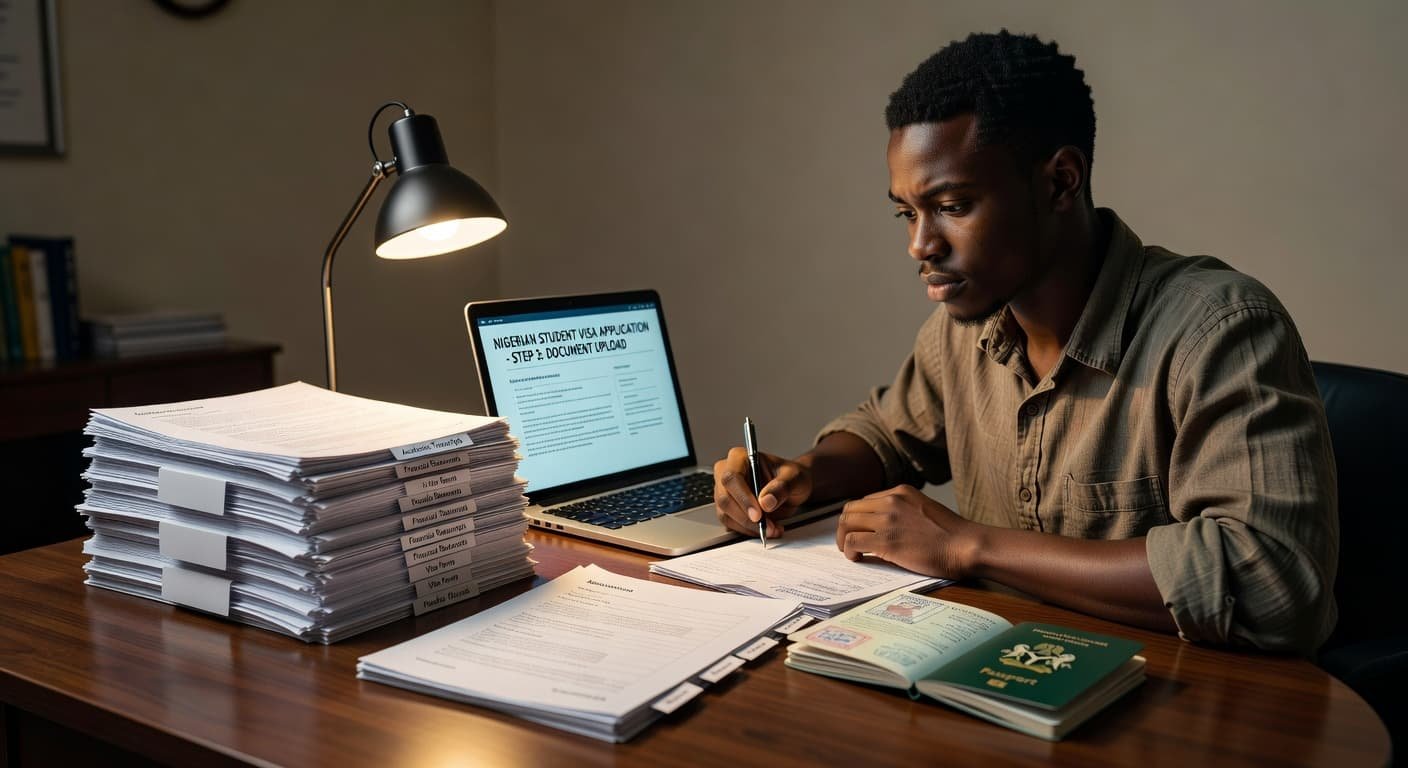
We keep originals in one sleeve and copies in another. If the embassy wants scanned uploads, we save each file with a clear name, such as passport, admission letter, bank statement, or transcript. Dates, spellings, and course titles should match across every page.
If a document is not in English, we use a certified translation. Some visa offices want the translator’s details attached. Others want a stamp or notarised copy. We do not guess. We follow the exact instruction on the official checklist.
If the rule says original, we bring the original. If it says copy, we still keep the original close by.
For bank papers, we also check that the account name and sponsor name match the rest of the file. If a parent or guardian is funding the trip, we include a sponsor letter, identification, and any supporting financial papers the embassy asks for. A single missing link can make the money story look thin.
Mistakes that trigger delays or refusals
Most refusals do not come from one huge error. They come from small gaps that should have been fixed early.
- Mixed spellings or dates: If our passport, school letter, and bank papers show different names, we pause and correct it first.
- Weak proof of funds: Sudden large deposits with no explanation raise questions. We keep the money trail clear.
- Expired documents: English test results, police clearances, medicals, and TB tests all have expiry windows.
- Wrong admission letter: A letter for a previous intake or a different course can sink the application.
- Missing sponsor evidence: If someone else pays, their letter, bank record, and ID should all tell the same story.
- Old online advice: Visa rules change. We check the official source, not a screenshot from last year.
A lot of applicants lose time because one document looks fine on its own but clashes with another page. The bank statement says one thing, the sponsor letter says another, and the course dates say something else. Embassy officers notice that fast.
If the school asked for a certified transcript, we do not send a plain photocopy. If the visa centre asked for a recent statement, we do not send an old printout. Tiny mismatches create big delays.
Our final review before submission
Before we book biometrics or an interview slot, we run one last pass through the file.
- We match every name spelling across passport, admission letter, test results, and bank papers.
- We check that the passport has enough validity for the country we are applying to.
- We confirm that our admission letter, CAS, I-20, or COE matches the course and intake date.
- We review the fund proof and make sure the sponsor story is clear.
- We separate originals, copies, and certified translations.
- We print or save appointment confirmations, fee receipts, and the visa form.
- We compare the file with the official embassy or visa-centre checklist one more time.
If we want the wider process after the document stage, our complete 2026 guide to studying abroad keeps the bigger picture in order.
Conclusion
The cleanest visa file is the one that fits the country, not the one that looks impressive in a stack. That is the real lesson behind any student visa checklist for Nigerian applicants in 2026.
We save time when we verify every document against official embassy, consulate, immigration, or visa-centre instructions, then organise the file so the story stays consistent from page one to the last receipt. One good checklist is useful. The right checklist, matched to the right country, is what keeps the process moving.
This post may contain affiliate links. If you make a purchase through these links, I may earn a small commission at no extra cost to you.

 Enu
Enu