
 Enu
EnuDreaming of permanent residency in Canada? You’ll learn how to spot when you can handle your application alone, like basic Express Entry profiles, and when a permanent residency lawyer Canada makes sense for tricky cases such as prior refusals or Provincial Nominee Program (PNP) streams. Common routes include Express Entry for skilled workers, PNP for province-tied candidates, and family sponsorship for relatives.
Always confirm requirements, fees, and policies on the official site like canada.ca/immigration.
Quick Answer (Read This First)
- Hire a lawyer if your case involves past refusals, criminal issues, misrepresentation risks, or complex PNP rules; otherwise, try DIY for simple profiles.
- Lawyers review eligibility, build strategies, spot gaps, prepare documents, submit applications, and handle IRCC queries or refusals.
- They can’t guarantee approval; IRCC decides based on rules.
- Check licenses via provincial law societies (e.g., Law Society of Ontario) or CICC for consultants.
- Prepare passport, job letters, language tests (IELTS/CLB), proof of funds, and prior visas before your first call.
- Costs vary widely by case complexity; expect legal fees plus IRCC charges.
- Timelines: Express Entry often aims for about 6 months from ITA to PR, but PNP or family can take 12-19 months; accuracy speeds things up.
- Avoid delays by matching details across forms, meeting deadlines, and using checklists.
Red flags when a PR lawyer is not a good fit
Promises of sure approval top the list. No one controls IRCC decisions.
Beware pressure to pay fast or vague fee talks. Good lawyers give written quotes upfront.
Claims to “fix” facts or hide issues signal scams. Stick to truth; misrepresentation bans you for years.
Poor responses or no retainer agreement? Walk away.
What a Permanent Residency Lawyer in Canada Does (and What You Still Need to Do)
A permanent residency lawyer Canada starts with your eligibility check across programs like Express Entry’s Federal Skilled Worker or PNP streams. They craft a plan, flag risks like weak work history, and outline documents.
You gather real proofs: pay stubs, tax returns, employer letters. Lawyers organize and submit, but truth comes from you.
They reply to IRCC notes, like procedural fairness letters after refusals, and appeal if needed. Some clients just need a one-hour consult for DIY tweaks; others want full handling.
No magic approvals exist. Lawyers boost odds through precision, not shortcuts. For 2026’s 380,000 PR spots focused on in-Canada workers, they align your profile right.
Lawyer vs licensed consultant vs DIY application
Lawyers hold provincial law society licenses; they argue in court and handle refusals. Regulated Canadian Immigration Consultants (RCICs) register with CICC for paid advice.
DIY works via IRCC portals if your case stays simple. Best for: DIY on strong Express Entry; consultants for basic support; lawyers on high-risk like criminality or appeals.
Common PR pathways where legal help often pays off
Express Entry needs solid NOC/TEER matches, funds proof (e.g., CAD 13,757 single), and CRS boosts. Lawyers verify language scores.
PNP ties to province rules, job offers; enhanced streams add 600 CRS points.
Family sponsorship proves genuine ties; Atlantic program needs employer buy-in.
Key Features to Look For in a Permanent Residency Lawyer Canada
- Active license in good standing with a law society or CICC registry.
- Clear fee agreement spelling out services, costs, and extras.
- Risk explanations for your pathway, like PNP caps or CRS trends.
- Document checklists tailored to Express Entry or family rules.
- Realistic timelines, noting 6-month Express Entry averages.
- Quick responses via email or portal, not just promises.
- Pathway experience, e.g., Ontario PNP successes; check Canadian Permanent Residence Lawyers.
Step-by-Step: How to Hire and Work With a Permanent Residency Lawyer in Canada
- Shortlist 3-5 via law society directories or CICC search.
- Verify license online; match name and status.
- Book a 30-60 minute consult; pay if needed.
- Bring docs: ID, tests, work proofs, prior apps.
- Review their written plan and quote.
- Sign retainer; pay deposit.
- Check drafts for accuracy; approve submission.
- Track via client portal; respond fast to IRCC.
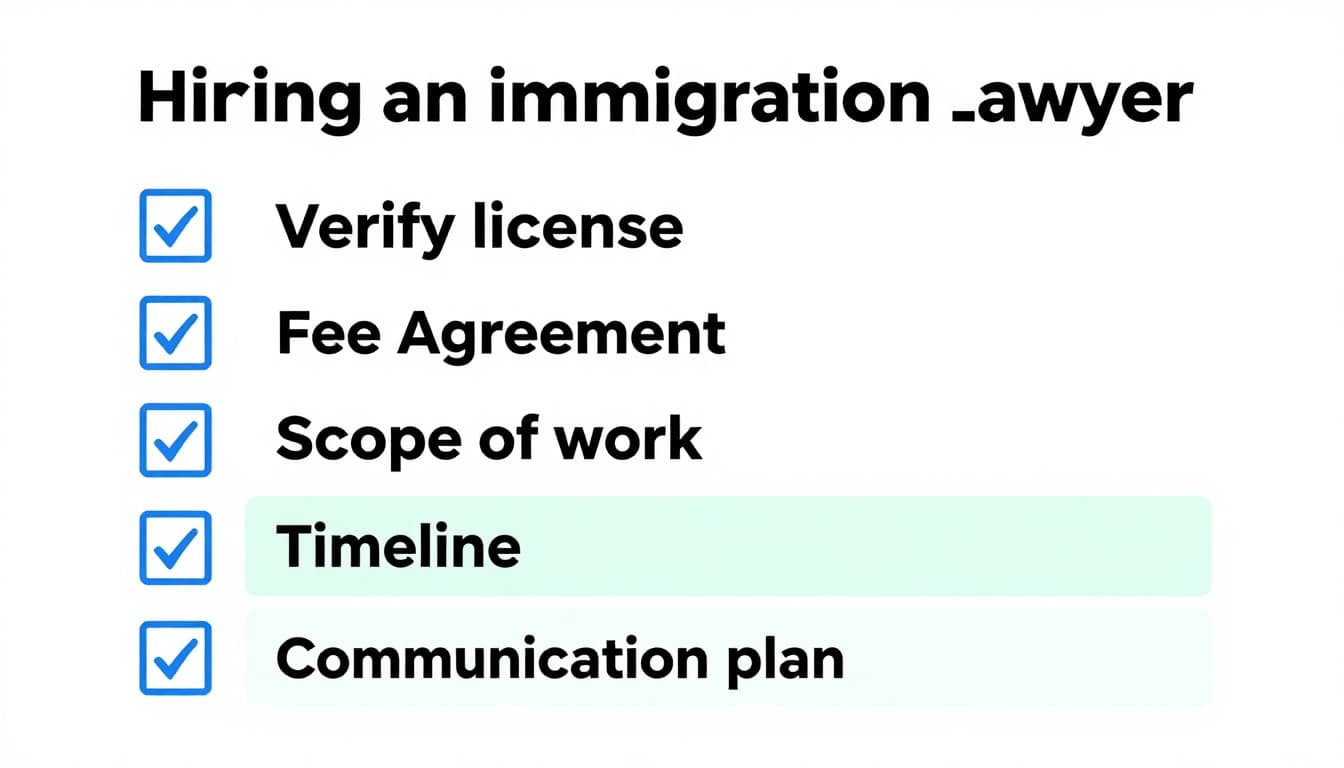
Before you pay checklist:
- Who handles your file daily?
- Total fee, inclusions, disbursements?
- Refund terms?
- Communication method and frequency?
Pricing, Fees, and What “Affordable” Really Means for PR Legal Help
Fees cover lawyer time, IRCC charges (CAD 1,525 main applicant), translations, assessments, tests, and couriers. Full service might add up; consults stay lower.
Example total (hypothetical): Lawyer fee (varies) + IRCC CAD 1,525 + CAD 500 translations + CAD 300 assessment = potential CAD 5,000+ range.
Compare by scope: one-off advice vs full rep. Cheap options risk refusals, extra appeals, lost time. For 2026 PNP surges (90,000+ spots), invest in precision.
Pros and Cons
| Aspect | Hiring a PR Lawyer | DIY Application |
|---|---|---|
| Cost | Higher upfront | Lower, but errors add fees |
| Speed | Guided to meet deadlines | You control, but mistakes slow |
| Stress | Less; expert handles complexities | High if rules confuse |
| Mistake Risk | Low; reviews catch issues | Higher without checks |
| Complex Cases | Strong support for refusals/PNP | Tough alone |
| Customization | Tailored strategies | Generic IRCC guides |
Common Mistakes (and How to Avoid Them)
- Inconsistent dates across forms: Cross-check everything.
- Weak reference letters: Use templates with duties, hours, salary.
- Untranslated docs: Get certified ones.
- Hiding old refusals: Disclose; explain in letter.
- Wrong proof of funds: Show liquid assets only.
- Missed deadlines: Set calendar alerts.
- Bad forms: Download latest from IRCC.
- Unlicensed help: Verify first.
Is a Permanent Residency Lawyer Canada Legit and Safe to Hire?
Check law society sites for standing or CICC registry. Match retainer name exactly.
Use secure payments; demand receipts. Read scope, refunds clearly.
Directories list pros but offer no endorsements or advice, like general info sites. No guarantees exist; focus on ethics.
Firms like Permanent Resident Lawyer in Canada stress accuracy.
FAQs
Do I need a lawyer for Express Entry?
No for basics; yes if CRS low or gaps exist.
Can a lawyer speed up my PR?
They prevent delays via clean apps; processing stays IRCC-set.
What if I had a refusal before?
Lawyers address reasons; disclose fully.
How do I check a lawyer’s license in Canada?
Search provincial law society or CICC public tools.
Should I use an agent from overseas?
Prefer Canada-licensed; verify credentials.
What documents should I prepare?
Passport, tests, funds proof, police checks.
What if my CRS is low and I need a PNP?
Target streams; lawyer matches province needs.
Can my spouse be included?
Yes; add them for open work permits.
What happens if IRCC asks for more documents?
Reply in time; lawyer drafts responses.
Conclusion
Pick DIY for straightforward Express Entry, a paid consult for doubts, or full permanent residency lawyer Canada for refusals or PNP twists. Matches 2026 shifts to in-country skilled workers.
Shortlist today, verify licenses, book a consult, gather docs. Your path to PR starts now.


 Enu
Enu