 Enu
EnuImagine landing that dream job offer from a Canadian employer. Excitement builds until you hit the visa wall. What documents do you need? Does your boss require special approval? Temporary work permit Canada requirements can feel overwhelming, but they follow clear rules from Immigration, Refugees and Citizenship Canada (IRCC).
This guide breaks it all down. You’ll learn the two main types of permits, who qualifies, exact documents, step-by-step application, fees, processing times, and 2026 updates like tighter rules for low-skilled roles. Whether you’re aiming for an employer-tied permit or a flexible open one, we cover it. Always check the official IRCC website for the latest, as rules shift. In January 2026, Canada prioritizes high-skilled workers while capping some temporary residents.
Data from IRCC shows employer-specific permits often need a Labour Market Impact Assessment (LMIA), while open permits skip it for spouses or graduates. Fees start at CAD 155. Processing varies by country and type.

Quick Answer: Key Temporary Work Permit Canada Requirements
Busy? Here’s the essentials:
- Two types: Employer-specific (closed, tied to one job/employer, often needs LMIA) or open (any employer, for spouses/grads).
- General eligibility: Prove you’ll leave Canada, show funds for living/return, clean criminal record, good health.
- LMIA needed for most closed permits; employer applies first.
- Core docs: Passport, job offer, LMIA/CAQ if required, police certificates, proof of funds.
- Apply online via IRCC portal; pay CAD 155+ fees, give biometrics.
- Medical exam if staying over 6 months or in healthcare/childcare.
- 2026 note: Stricter for low-skilled extensions; high-skilled prioritized.
Types of Temporary Work Permits Available in Canada
Canada offers two core temporary work permits. Employer-specific ones lock you to one employer and job. Open permits give freedom to work anywhere except restricted spots.
Most fall under the Temporary Foreign Worker Program (TFWP) for closed types or special categories for open ones. In 2026, expect fewer spots for low-skilled open permits, like some spousal ones.
Employer-Specific Work Permits
These tie you to one employer, one job, one location. Your boss usually gets an LMIA first, proving no Canadian fits the role. Exemptions exist for intra-company transfers or trade deals.
Quebec jobs need a CAQ too. With 2026 tightening, low-skilled (TEER 4-5) roles face hurdles on new hires and extensions. High-skilled (TEER 0-3) stay easier.
Open Work Permits
Flexibility rules here. Work for any compliant employer. Common for spouses of skilled workers/students, Post-Graduation Work Permit (PGWP) holders, or TR-to-PR applicants. See IRCC’s open permit page for extensions to December 2026.
No LMIA required. But 2026 cuts target lower-skilled spouses.
Eligibility Rules for Temporary Work Permit Canada Requirements
IRCC checks if you’re admissible. You must intend to leave after your permit ends, support yourself, and pose no risk.
Job-specific rules apply too, like matching wage standards for closed permits.
General Eligibility Criteria
Show ties to home (family, property, job). Provide bank statements or pay slips for funds. Expect questions on your plans.
Health and Security Checks
Medical exam mandatory for stays over 6 months, or jobs near kids/healthcare/agri-food. Use IRCC panel physicians; results go direct to them.
Police certificates from countries lived in 6+ months since age 18. Explain if unavailable. No serious crimes or security risks allowed.
Required Documents for Your Work Permit Application
Gather these before starting. IRCC’s questionnaire creates your personalized list.
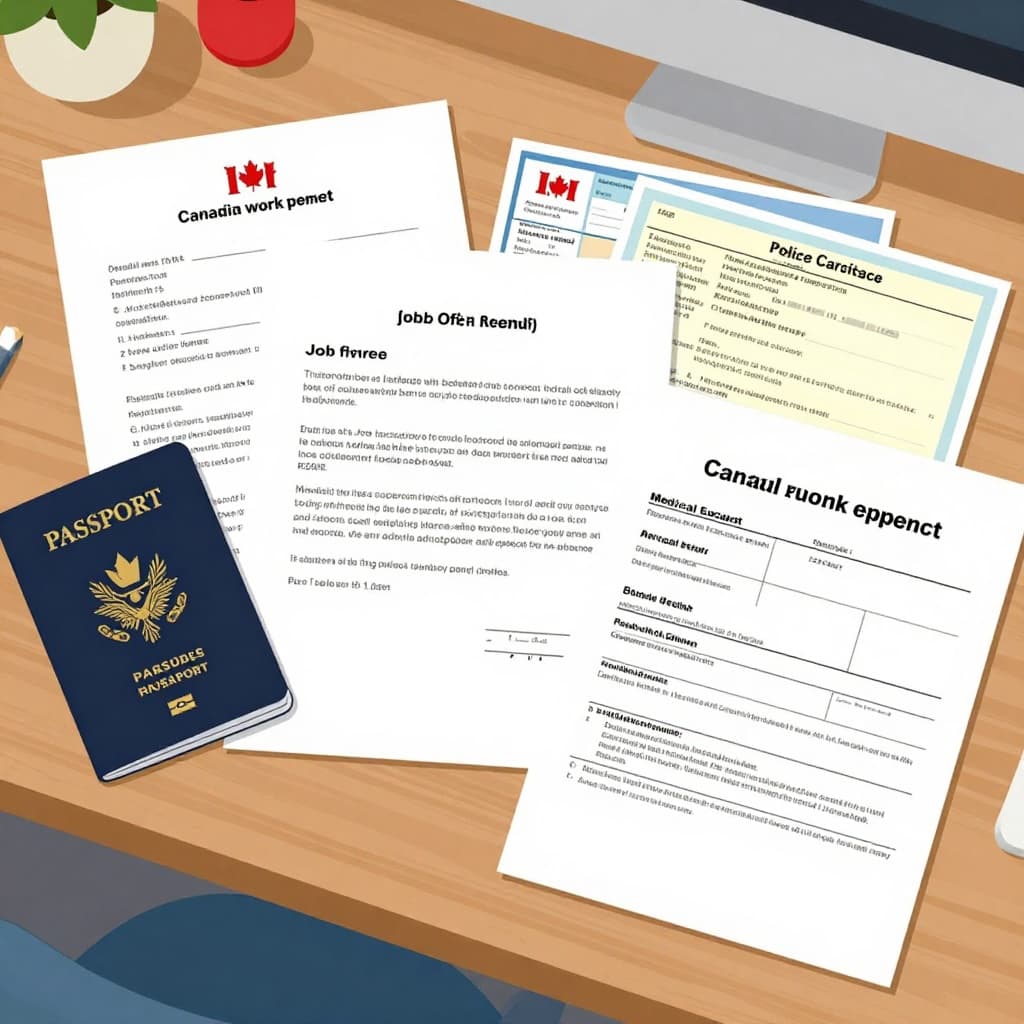
- Valid passport (all pages).
- Digital photo (IRCC specs).
- Job offer letter and LMIA/CAQ if needed.
- Forms like IMM 1295 or 5710 (auto-filled online).
- Proof of funds (statements covering 3-6 months).
- Police certificates and medical receipt if applicable.
- Family docs (marriage certs) for dependents.
- Biometrics receipt post-appointment.
Use VFS Global centres for biometrics in many countries.
Step-by-Step: How to Apply for a Temporary Work Permit in Canada
Start online at IRCC’s portal. Answer questions for your checklist.
- Confirm eligibility with IRCC tool.
- Create or log into account.
- Upload all docs and forms.
- Pay fees (credit card).
- Submit biometrics via letter.
- Track status; respond to requests.
- Receive decision (letter or at border).
Before submitting: Valid passport? Complete forms? Fees paid?
Applying from Outside Canada
Get a port of entry (POE) letter. Need TRV/eTA too? Officer issues permit on arrival.
Applying from Inside Canada
Must hold valid status. Apply for extensions 30 days early. Maintained status lets you work during wait.
Fees, Processing Times, and Extensions in 2026
Fees (CAD): Work permit $155/person. Open permit extra $100. Biometrics $85/person or $170/family max. Total for single closed: ~$240.
Processing: Check IRCC tool; 2-6+ months by country/type. High-skilled faster.
Extensions: Apply early online. Prove ongoing need. 2026 stricter for low/mid-skilled; high-skilled prioritized. Maintained status applies if timely.
Common Mistakes and How to Avoid Them
- Missing LMIA: Confirm if employer got it; use exemptions wisely.
- Incomplete docs: Follow checklist exactly; scan clearly.
- Late biometrics: Book within 30 days of BIL.
- Wrong application spot: Outside? Use POE path. Inside? Status matters.
- No funds proof: Show 3+ months statements.
- Expired medical/police certs: Do upfront if risky.
- Late extensions: Apply 30 days before expiry or face restoration ($200+ fee).
Use IRCC checklists to stay safe.
Temporary Work Permit Canada Requirements FAQs
Do I need an LMIA?
Usually yes for closed permits; employer handles it. Open skips.
When is a medical exam required?
Over 6 months stay or certain jobs like childcare.
How long does processing take?
Varies; check IRCC tool for your case (weeks to months).
Can I extend my permit?
Yes, apply early with job proof. 2026 tighter rules apply.
What about family?
Spouses/kids may get open permits; include docs.
Need help?
Try consultants like StudyIn, but verify with IRCC first.
Quebec jobs?
Add CAQ application.
Conclusion
Temporary work permit Canada requirements boil down to eligibility proof, docs like LMIA/job offer, online application, and fees around CAD 155+. Master closed vs open types, health checks, and steps for success. In 2026, high-skilled paths shine amid cuts.
Run IRCC’s eligibility tool today. Check Canada.ca always. Services like VisaHQ or VFS Global ease biometrics. Ready for your Canadian job? Start now.

 Enu
Enu