 Enu
EnuImagine landing a solid job offer from a Canadian company that matches your skills perfectly. Now picture getting stuck because your work permit ties you to just that one role. An employer specific work permit Canada lets you work for one employer, one job, and often one spot, but it opens doors to real opportunities in a country hungry for talent.
This guide breaks it all down for 2026. You’ll learn eligibility rules, the full application steps, fees, processing times, pros and cons, pitfalls to dodge, and safety checks. With Canada’s push for high-skilled workers in NOC TEER 0-3 jobs, now’s a smart time to act. Always check the latest on the official IRCC website at canada.ca since rules shift fast.
Quick Answer (Read This First)
- Definition: Closed permit for one employer, job, and location only; switch means new permit.
- LMIA often required: Employer proves no Canadians available unless exempt.
- Key eligibility: Valid job offer, proof of funds, intent to leave Canada, clean record.
- Main docs: Job offer letter, LMIA number or exemption code, passport, photos.
- Fees: $155 work permit + $230 employer compliance + $85 biometrics (check IRCC for exact).
- Processing: 8-24 weeks; faster online for high-skilled.
- Vs open permit: No employer tie here; open lets you work anywhere.
- 2026 focus: High-skilled priority, stricter extensions for low-wage roles.
What Is an Employer Specific Work Permit Canada and What Does It Do?
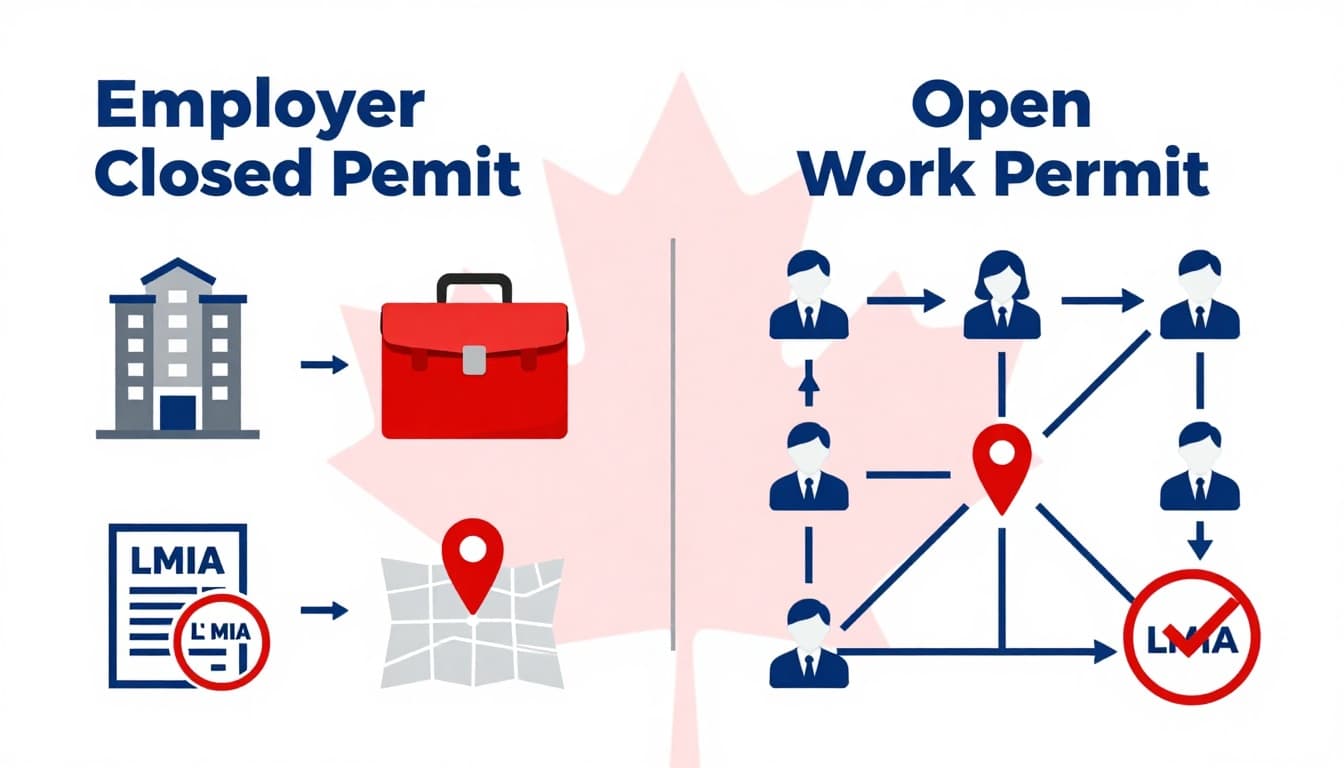
An employer specific work permit Canada is a closed work permit. It names one employer, one job, and usually one city or site. You can’t freelance or jump companies without starting over.
This permit fills gaps where Canadians lack skills. Employers often get a Labour Market Impact Assessment (LMIA) first. That proves they tried hiring locals. If approved, they hand you the LMIA letter and job offer for your application.
Open permits differ; they let you pick any boss. But employer specific ones suit committed roles, like tech or trades. In Quebec, add a CAQ. You must prove funds for yourself and family, plus pass medical or police checks if needed. For 2026, high-skilled spots (managers, pros) stay open while low ones tighten.
Key Features of Employer Specific Work Permit Canada
- Tied to specifics: One employer, job title, and location; changes need fresh approval.
- Duration fits offer: Often 1-3 years; matches contract length.
- LMIA or exemption base: Employer handles this; you use their number or code.
- Spousal options: Some high-skilled get open permits for partners.
- Extensions possible: But 2026 demands proof of ongoing need and wage match.
- PR pathway: Builds Canadian experience for Express Entry or PNPs.
- High-skilled edge: NOC 0-3 prioritized; language tests may join for some.
Step-by-Step: How to Apply for Employer Specific Work Permit Canada
- Employer checks if LMIA needed; applies to ESDC if yes, waits for positive result.
- Get your job offer letter, LMIA decision, or exemption code and offer number.
- Collect docs: passport (valid 6+ months), 2 photos, proof of funds (bank statements), ties to home.
- Create IRCC online account; pick “work permit” and employer-specific stream.
- Fill form, upload everything; select LMIA or exempt category.
- Pay fees online; book biometrics at VFS if outside Canada.
- Do medical exam or police cert if flagged (check IRCC tool).
- Submit and track; get letter of introduction, then activate at border.
Before you submit checklist:
- Valid passport and job offer match?
- Positive LMIA or valid exemption code?
- Funds cover 3-6 months (e.g., $2,500+ single)?
- Quebec CAQ if headed there?
- All docs in English/French or translated?
Apply online for speed. Use VFS centers in some countries for biometrics.
Fees, Processing Times, and What to Expect for Employer Specific Work Permit Canada
Expect these core costs in 2026: $155 CAD for the work permit, $230 CAD employer compliance fee (per spot), and $85 biometrics per person. Add $200+ for medicals, translations, or travel. Total around $500 CAD, but confirm via IRCC tool as no big hikes noted yet.
Processing runs 8 weeks inside Canada, 12-24 outside. High-skilled files with full docs move quicker. Country, volume, and checks affect it; track online.
| Cost Item | Amount (CAD) | Who Pays |
|---|---|---|
| Work Permit | 155 | Worker |
| Employer Compliance | 230 | Employer |
| Biometrics | 85 | Worker |
| LMIA (if needed) | 1,000 | Employer |
Pros and Cons of Employer Specific Work Permit Canada
This permit offers stability but locks you in. Students who’ve used similar paths praise consultant help for smooth visas.
| Pros | Cons |
|---|---|
| Job security with named employer | Can’t switch jobs without new permit |
| Employer covers LMIA costs often | LMIA process delays start (weeks) |
| Builds PR points via experience | Stuck in one location usually |
| High-skilled fast-tracked in 2026 | Extensions harder; prove need |
| Spousal work rights possible | Risk if employer drops you |
Common Mistakes (and How to Avoid Them) When Applying for Employer Specific Work Permit Canada
- Wrong LMIA: Use only positive; fix by asking employer to confirm status.
- Weak funds proof: Show 3-6 months statements; avoid new deposits.
- Skip Quebec CAQ: Apply early if headed there; check provincial site.
- Miss biometrics window: Book right after submit; extend if needed.
- Fake offers: Verify employer legitimacy; no upfront agent fees.
- No police cert: List stays over 6 months; get from home country.
- Ignore intent to leave: Add family ties, return job proof.
- Poor translations: Use certified; IRCC rejects stamps alone.
- Late medical: Do before submit if job requires.
Double-check IRCC lists; consultants like those aiding students catch these.
Is Employer Specific Work Permit Canada Legit and Safe?
Yes, it’s an official IRCC program. Government oversees it, so safe when done right. Watch job scams; real employers don’t charge you.
Verify LMIA on ESDC site, use official portals. Trusted helpers, like firms guiding thousands to UK/Canada unis, ease stress without risks. Check VisaHQ for extras, but stick to canada.ca.
Tips for a Successful Employer Specific Work Permit Canada Application
- Start 3-6 months early; LMIA takes time.
- Confirm LMIA-exempt if intra-company or trade deal fits.
- Craft strong job offer with duties, wage, hours.
- Prep for border questions; carry all docs.
- Use VFS for biometrics in your country.
- Track status weekly via IRCC account.
- Show extra funds beyond job salary.
- Brush up English/French; 2026 may test some.
- Get employer compliance proof upfront.
- Backup with PR plans if long-term.
Employer Specific Work Permit Canada FAQs
Can I change employers on an employer specific work permit Canada?
No, apply for a new one; bridge with maintained status if extending.
Is LMIA always needed?
Usually yes for TFWP; exempt for IMP like transfers.
Can spouses work?
Yes, open permit if your job qualifies (high-skilled).
What’s the processing time?
8-24 weeks; check IRCC tool by country.
Any 2026 changes?
High-skilled priority; tougher low-wage extensions.
How to extend?
Same process; prove ongoing shortage, apply before expiry.
Do I need a medical?
If staying 6+ months or risky job.
Quebec special rules?
Yes, get CAQ first.
Conclusion
An employer specific work permit Canada suits those with a firm job offer, especially high-skilled roles in 2026. Weigh the stability against flexibility; check your fit via IRCC eligibility.
Visit canada.ca now, grab your docs, and consult a pro. Start your Canada work journey today; real jobs wait.


 Enu
Enu