 Enu
Enudo flights ever get cheaper last minute is the question you ask when the calendar’s tight and the price looks like it’s trying to punish you. You’re not imagining it, most fares rise as departure gets closer, and the steepest jumps often hit right when you can least afford them.
Still, there are a few real cases where prices can dip late, but they’re the exception, not the rule. If you’re flexible on time, airports, and even the exact destination, you can sometimes catch a late drop, especially on weak-demand flights.
Important disclaimer: Airfare changes fast, sometimes hour by hour. Results are never guaranteed, and this guide can’t account for every fare rule, route, or airline policy. Before you book, always confirm the airline’s fare conditions (changes, refunds, baggage, and boarding rules) on the airline’s official site and review the terms shown at checkout. You’ll get practical steps here, not hype, so you can make a smart call even when your trip is soon.

Do flights ever get cheaper last minute? The honest answer (and what the data usually shows)
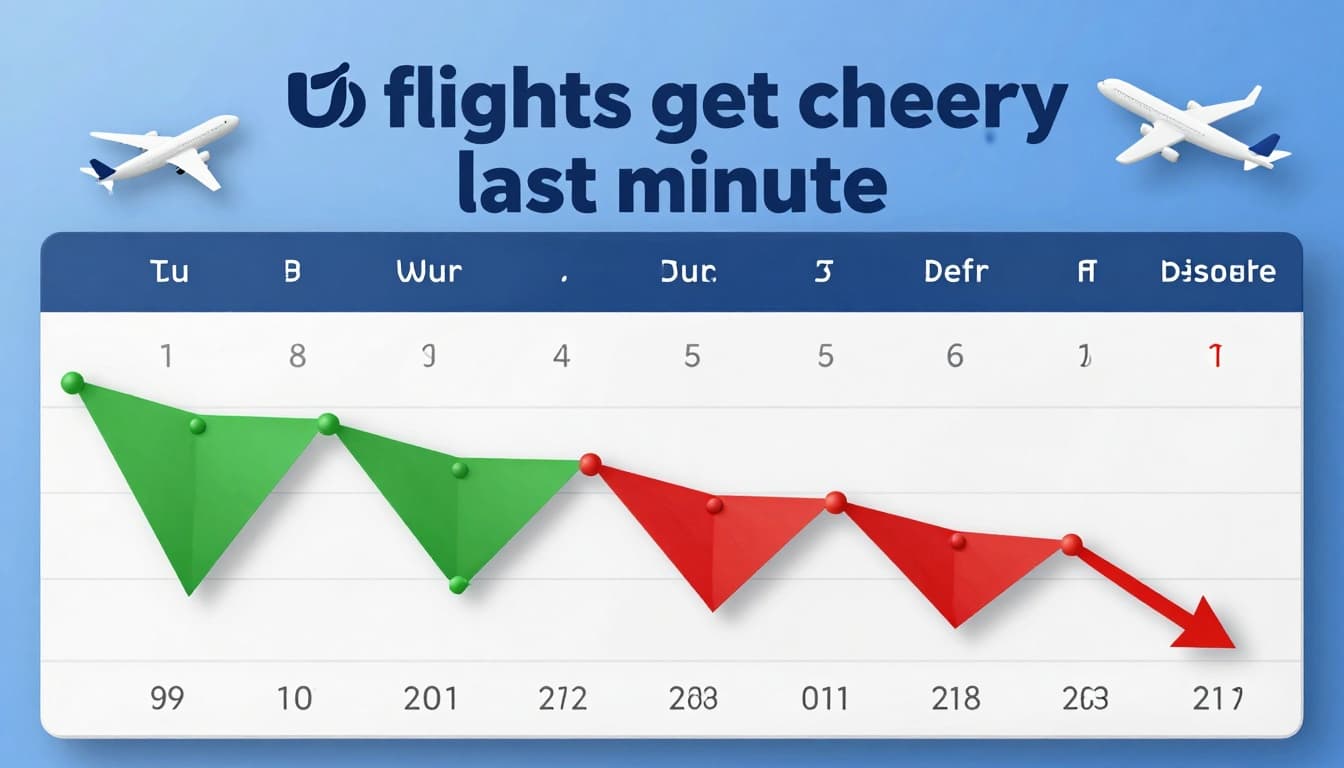
Most of the time, do flights ever get cheaper last minute has a frustrating answer: usually not. Airlines use dynamic pricing, which means the fare moves based on demand, how many seats are left, and how likely the airline thinks it can sell the remaining seats at higher prices.
Think of the plane like a shelf that empties. Early on, the airline releases some cheaper tickets to get momentum. As the flight starts filling, the cheap options disappear and you’re left choosing from more expensive seats.
Here’s what the pattern often looks like in 2025 data and booking studies:
- For many domestic and short-haul routes, you often see better pricing when you book about 1 to 3 months ahead rather than inside the final weeks.
- For many international routes, the “sweet spot” is often reported around 18 to 29 days out (it varies by route, season, and airline), but it still usually beats buying in the final week.
- Prices frequently jump 10 to 14 days before departure, because the airline shifts toward selling to urgent travelers and the remaining cheaper fare bands are gone.
If you want a current benchmark for timing and seasonality, the Expedia 2025 Air Hacks Report is a useful reference point, especially on how booking day and month can influence price on average (even if your route behaves differently): Expedia 2025 Air Hacks Report (Expedia Newsroom).
You don’t need to predict the “lowest possible fare” to win. Your real goal is to avoid buying during the most expensive window and to protect yourself if the price drops after you book.

Why prices often go up close to takeoff (demand, fewer seats, business travelers)
Airlines don’t sell “one price.” They sell chunks of seats at different price levels. When the cheap chunk sells out, the next chunk costs more. You don’t see the chunks, you just see the price jump.
Close to departure, three forces push fares higher:
1) Fewer low-price seats remain.
If you’re shopping late, you’re often choosing from the expensive chunks by default.
2) Urgent travelers pay more.
Work trips, family emergencies, and last-minute schedule changes create buyers who can’t wait. Airlines price for that reality.
3) The flight is closer to full.
Even if you notice open seats on the seat map, that doesn’t mean the flight is “empty.” Many seats may still be unsold but priced for higher demand.
Quick example you can picture: you check Berlin to Barcelona three weeks out and see a fair price. You wait. Ten days before departure, the cheaper chunk is gone, and the same flight is suddenly €80 to €200 more, even though the plane still has open seats.
When last-minute fares can drop (rare, but real)
Yes, do flights ever get cheaper last minute sometimes has a “surprisingly, yes” outcome. It usually happens when the airline misjudged demand or a new factor changes the playing field.
The most realistic late-drop scenarios are:
Unpopular flight times: very early departures, late-night arrivals, or odd connections.
New competition: a rival airline starts or expands a route and triggers a quick response.
Schedule changes: times shift, aircraft changes, or the airline adjusts inventory.
Off-season midweek travel: Tuesday and Wednesday flights outside school breaks can stay soft.
A flight that’s still very empty: uncommon on popular routes, more common on niche city pairs.
The catch is simple: these drops are not dependable. If you want them, you need flexibility on departure time, nearby airports (Frankfurt, Düsseldorf, Cologne, Munich, Berlin), and sometimes the destination itself.
Last-minute flight deals myths vs reality (including “do flights get cheaper last minute reddit” stories)
If you’ve ever searched do flights ever get cheaper last minute, you’ve probably seen a viral story: someone booked a flight “the night before” for a price that looks impossible. That doesn’t mean the market is secretly full of last-minute bargains. It usually means the traveler changed the rules in a way the screenshot doesn’t show.
That’s the gap between anecdotes and what most people experience:
- One person is flying Hamburg to London Stansted at 06:10 with only a small personal item.
- Another person is flying Munich to Heathrow Friday evening with checked luggage.
- Both call it “the same trip,” but the pricing system does not.
Reddit posts also tend to compress details. The cheap fare might be:
- a points booking (cash price irrelevant)
- a promo that lasted hours
- a different airport pair than you’re searching
- a one-way that looks cheap until you price the return
- basic economy with strict limits
So, when you read “do flights get cheaper last minute reddit says yes,” don’t copy the outcome. Copy the method: flexibility, fast booking, and a willingness to accept tradeoffs.
Myth: Airlines slash prices the night before to fill seats
It’s a nice story, but airlines usually don’t need to dump inventory at the last second. They’re not pricing to “fill the plane,” they’re pricing to maximize revenue from the remaining seats.
Empty seats also don’t force a discount. If the airline believes late demand is still coming (business travelers, event traffic, disrupted passengers), it protects higher prices instead of training buyers to wait.
Reality: “Cheap last minute” often means you changed the rules (time, airport, luggage, or comfort)
If do flights ever get cheaper last minute feels true for someone else, look for the hidden tradeoffs. These are the usual ones:
Red-eyes and dawn flights: cheaper because fewer people want them.
Long layovers: you “pay” with time.
Separate tickets: sometimes cheaper, but riskier.
Basic economy limits: less flexibility, stricter baggage rules.
Fees that don’t show in the headline price: bags, seats, priority boarding, payment fees.
Before you celebrate a “deal,” compare the total trip cost, including luggage, seat selection, airport transfers, and an extra hotel night if the timing forces it.
How to get the best price if your trip is soon (smart strategies that actually work)
When time is short, you need moves that improve your odds without gambling. The safest mindset is: you’re not trying to “win the lowest fare,” you’re trying to avoid overpaying and keep options open.
Here’s the playbook that works well when do flights ever get cheaper last minute is your reality and you need to book soon.

Use price alerts and flexible date calendars to spot real dips
Start with alerts because last-minute drops can appear and vanish the same day. You want a system that watches while you live your life.
What to do today:
- Set alerts for your exact route and also for nearby airports (for example, Frankfurt and Köln Bonn, or Munich and Nürnberg).
- Check a flexible date calendar and scan 2 to 3 days on each side of your target.
- Look at early morning and late-night departures, because those often price lower.
When you see a dip, don’t wait for a second dip that may never come. Decide what “good enough” means for your route, then book when you hit it. That’s how you win last-minute pricing without stress.
Book now, then recheck prices (how rebooking can save you without gambling)
If you’re worried because do flights ever get cheaper last minute keeps nagging you, use a safer approach: book a fare you can live with, then keep watching.
This works when your ticket allows changes or refunds. Many major airlines have eased change fees on certain fare types, but basic economy often has stricter rules. Budget carriers may also price changes in a way that wipes out savings.
Your checklist before you use this strategy:
- Confirm your fare type (basic vs standard).
- Confirm whether a price drop becomes a credit or a refund.
- Confirm deadlines for changes and whether fare differences apply.
If the price falls and your fare allows it, you change or rebook. If it doesn’t, you still have a trip locked in.
Try nearby airports, split tickets, and one-way comparisons
This is where you can create your own “deal,” even when last-minute pricing is harsh.
Practical ways to do it:
Nearby airports: fly into a larger hub, then take a train for the final leg. From Germany, rail links can make this painless, for example flying into Frankfurt then continuing by train.
Split tickets: outbound on one airline, return on another.
One-way comparisons: sometimes two one-ways beat a round-trip, sometimes the opposite, you only know by pricing both.
One warning: if you build a trip from separate tickets and you miss the second flight due to a delay, the second airline may treat you as a no-show. Leave a generous buffer or stay overnight if it’s tight.
Airline rules that matter for last-minute bookings (refunds, credits, and fare types)
If you’re chasing a lower fare, rules can turn “cheaper” into “more expensive” fast. The closer you are to departure, the less time you have to fix mistakes.
Another disclaimer worth stating clearly: airline policies vary by carrier, route, country, and fare brand, and they change. Before you buy, verify the exact rule set on the airline’s official site and read the terms on the checkout page.
Basic economy vs standard economy: why “cheapest” can cost more later
Basic economy is priced to look irresistible when you’re staring at a countdown clock. But on a last-minute purchase, flexibility often matters more than saving €25.
Common pain points you can run into:
- Changes not allowed or allowed with high fees
- Late boarding groups and limited overhead bin space
- Seat assignment limits (you may sit apart)
- Baggage surprises, especially if your “cabin bag” isn’t included
When do flights ever get cheaper last minute is your situation, standard economy can be the smarter buy if it gives you the option to rebook when prices move.
Know your safety nets: 24-hour cancellation, travel insurance, and credit rules
Many travelers don’t use the easiest safety net: a 24-hour cancellation window that can apply in some markets and situations (rules differ by region and seller). If you want a clear explainer on how that rule commonly works, read: The 24-Hour Flight Cancellation Rule.
Travel insurance can help in some last-minute cases, but it’s not automatic protection from price swings. If you’re considering it, read the policy wording carefully (what’s covered, what’s excluded, and what counts as a covered reason). For simple price-drop protection, a flexible fare is usually the more direct tool.
FAQ: Do flights ever get cheaper last minute? (quick answers to common searches)
Do flights ever get cheaper last minute for domestic trips?
Usually, domestic and short-haul fares rise in the final days. The best pricing often shows up weeks earlier, not within the last 7 days.
It can still drop if you’re flexible, especially on off-peak midweek flights or unpopular times. If you must book within a week, price nearby airports, look at early or late departures, and consider one-way combinations.
Do flights ever get cheaper last minute for international flights?
International pricing can be less predictable because there are more fare rules, fewer direct competitors on some routes, and bigger swings around holidays.
Even so, last-minute international tickets are often costly. Your best levers are flexibility on dates, alternative departure airports (for example, Frankfurt vs Düsseldorf), and points or miles if you have them.
Do flights get cheaper last minute on Tuesday?
The “Tuesday is cheapest” idea is older than many current pricing systems. Booking day effects are usually smaller than demand, season, and how full the flight is.
Some studies still find patterns, and Sunday often tests well for booking on average. The better move is to track your route with alerts and buy when the price hits your target, not when the calendar says Tuesday.
Do flights get cheaper last minute on the same day?
Same-day tickets are usually expensive because they’re aimed at urgent travelers. That’s the market airlines price for.
Rare exceptions exist, like odd-hour flights with weak demand or last-minute inventory adjustments. If you need to fly today, check alternate airports, accept a red-eye, and price points bookings if you have them.
Do flights ever get cheaper last minute reddit says yes, why did it work for them?
Most “proof” posts leave out the constraints they accepted. They might have flown at 05:40, packed light, or used points. They might also have compared different airports or grabbed a fare that lasted minutes.
Copy the system, not the screenshot: set alerts, stay flexible, and be ready to book fast when the price hits.
Conclusion
If you’re still asking do flights ever get cheaper last minute, the core truth is simple: usually no, especially on peak dates. But you’re not stuck paying the worst price either. You can still save with flexibility, nearby airports, one-way comparisons, and alerts that catch short-lived dips.
The safest approach is to book when the fare is reasonable, then recheck prices if your ticket rules allow changes. Pick your travel window, set alerts today, and verify airline rules before you buy, because the fine print is where a “cheap” last-minute ticket can turn expensive.


 Enu
Enu